Why Hospital Charges Are So Much Higher Than Payments
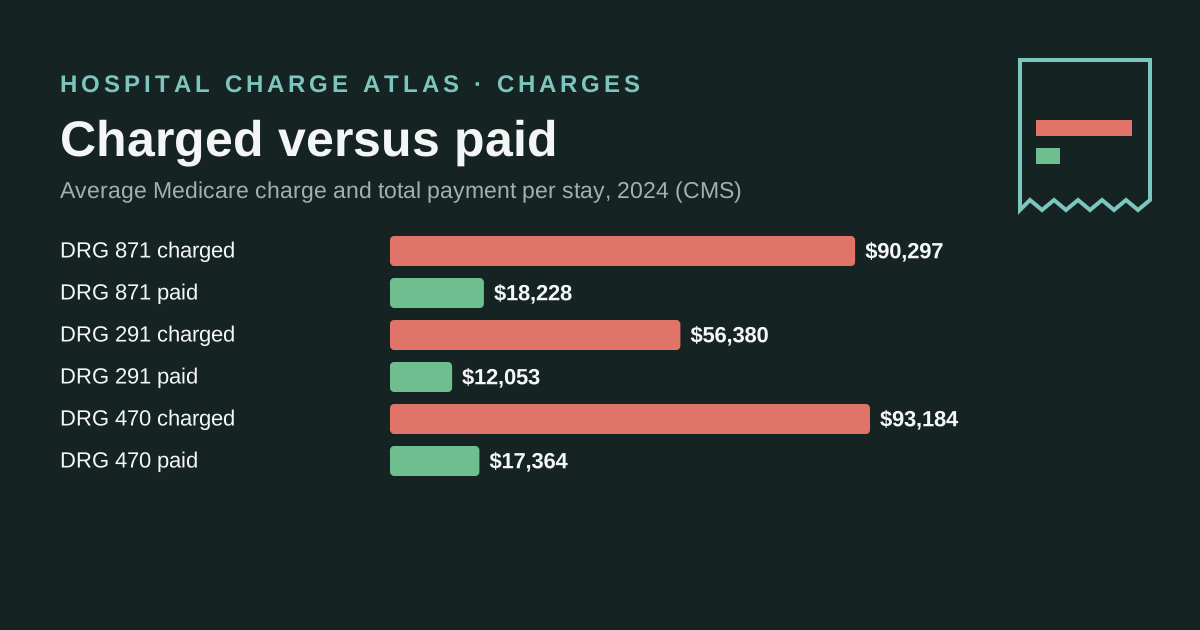
Look up any hospital stay on this site and two numbers appear: what the hospital charged and what it was paid. For Medicare's most common stay, septicemia with major complications (DRG 871), the average charge in 2024 was $90,297 and the average payment $18,228. Heart failure with major complications (DRG 291): $56,380 charged, $12,053 paid. A hip or knee replacement without major complications (DRG 470): $93,184 charged, $17,364 paid.
The chargemaster
Every hospital keeps a chargemaster: a list price for each of tens of thousands of items, from a night in a bed to a single tablet. The hospital sets these prices itself. They are the starting point for every bill, but they are not what most payers pay.
Who pays what
- Medicare pays a fixed amount per stay for each DRG, set nationally and adjusted for local wages, teaching and the hospital's share of low-income patients. The hospital's charge does not change what Medicare pays for a typical stay.
- Medicaid pays state-set rates.
- Commercial insurers negotiate their own rates — usually above Medicare's, and sometimes as a discount off charges, which gives hospitals a reason to keep charges high.
- Uninsured patients are the group most exposed to the list price, although most hospitals have financial-assistance policies and many offer self-pay discounts on request.
How big the gap is
Across hospitals with at least 100 Medicare stays, the median hospital charged 4.15 times what it was paid. The state medians run from 1.12 in Maryland to 8.44 in Nevada. Maryland is the exception because a state commission sets hospital rates for every payer, Medicare included, under a federal waiver — so a Maryland hospital's charge is close to what it is paid.
What the gap does and doesn't tell you
A high ratio says a hospital's list prices are high relative to Medicare's payments. It does not say the hospital is more expensive for an insured patient — that depends on its negotiated rates, which since 2021 hospitals must also publish under the price-transparency rule. Nor does it measure quality.
For the procedure you are facing, use the hospital comparison, then ask the hospitals on your shortlist for an estimate based on your own coverage.
Questions
Does anyone pay the full hospital charge?
Rarely. Medicare and Medicaid pay set rates and commercial insurers pay negotiated rates. Uninsured patients are the group most likely to be billed near the full charge, though most hospitals offer discounts or financial assistance.
Why are hospital charges higher in some states?
Charges are set by each hospital. In Maryland, a state commission sets rates for all payers, so charges sit close to payments; in states without rate setting, hospitals' list prices have drifted far above what any payer actually pays.